 FREE
FREE AI CHATBOT
 ANALVIDS
 UNDRESS
Pornography 2026: Creator Sovereignty, AI, and the End of Middlemen
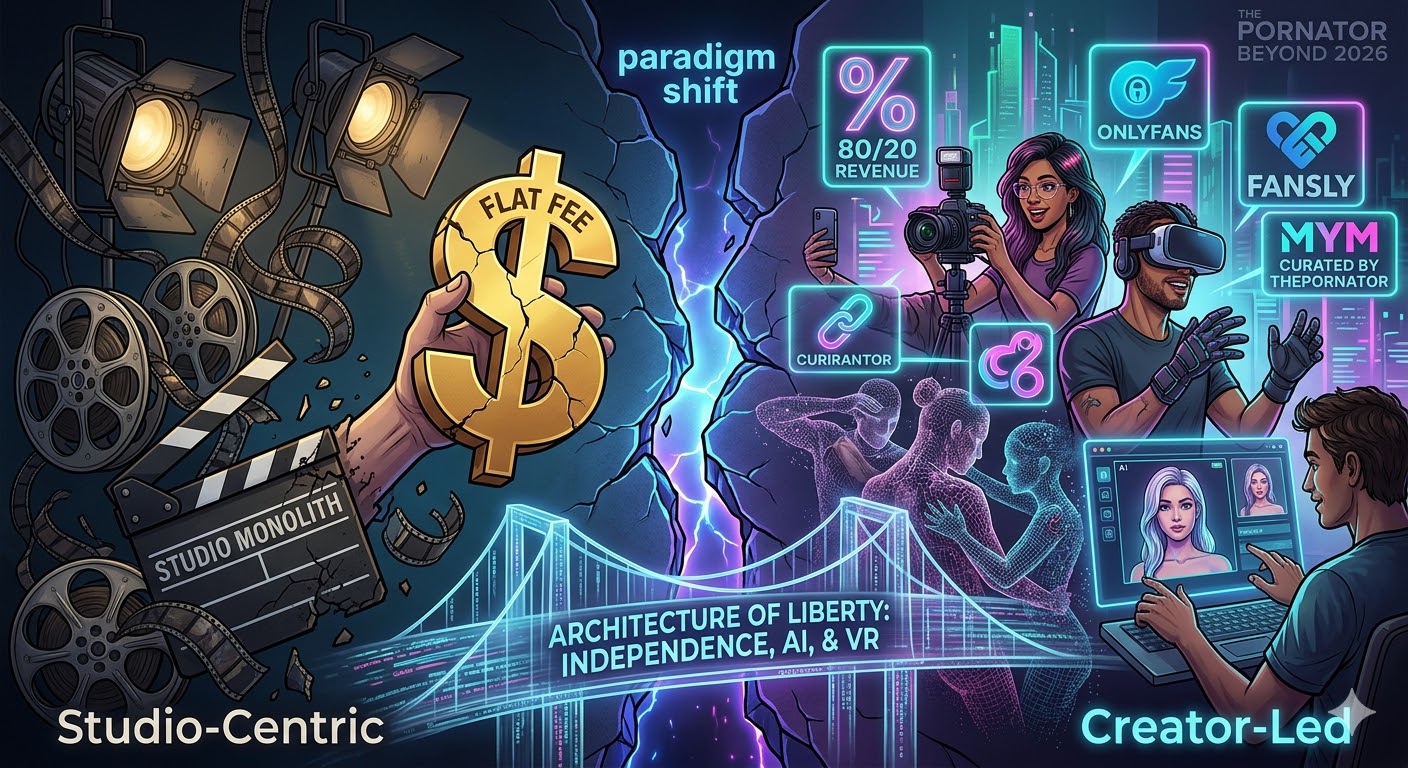
For decades, the adult industry operated like Hollywood: a vertical system where a few studios dictated beauty standards, scripts, and, above all, the distribution of wealth. But we have crossed a point of no return. Today, the "consumer" has become a "fan," and the actor has become a "creator." This is not just a technical evolution; it is a structural revolution: the center of gravity has shifted from Californian film sets to the individual's bedroom, armed with a smartphone and a fiber connection.
Part 1: The Collapse of the "Studio-Centric" Model (History and causes of the transition)
For nearly half a century, the pornographic industry functioned according to a model modeled after the Golden Age of Hollywood. To exist, an actor or actress had to go through the "front door" of the major studios. These entities owned everything: the cameras, the film sets, the distribution contracts, and above all, the power of life or death over the performers' media presence. But between 2010 and 2025, this house of cards collapsed. It wasn't a single cause, but a convergence of technological, economic, and sociological factors that made the traditional model obsolete.
1. "Tubification" or the studios' kiss of death
It all began with the advent of "tube" sites (Pornhub, XVideos, etc.). Initially, these platforms were allies of the studios, providing a global storefront. Quickly, they became their predators. By allowing the massive hosting of pirated or "amateur" content, the tubes accustomed the public to total free access.
The studios' economic model relied on the sale of DVDs, then VOD, and subscriptions to niche sites. When "premium" content found itself drowned in an ocean of free 10-minute clips, the perceived value of professional production plummeted. Studios tried to fight back by producing more for less, often sacrificing quality and the working conditions of the actors. This was the beginning of a deflationary spiral from which they never recovered.
2. The crisis of authenticity: "Gonzo" vs. Cinema
The public of the 2020s radically changed its tastes. Studio porn, with its artificial lights, predictable scripts, and sets in villas rented by the day, began to ring hollow. A disconnect was created between the "sold" fantasy and the reality of the viewers.
The rise of the "Gonzo" style (handheld camera, direct interaction) showed that users were looking for a form of proximity, or even truth. The polished 4K aesthetic of the studio seemed sterile compared to a 1080p video of a couple filming their encounters in their own bedroom with an iPhone. This quest for authenticity shifted the viewer's interest from the work (the film) to the person (the creator). The studio, by its very nature as a corporate structure, could not offer this organic intimacy.
3. The production tool: From the crane to the smartphone
Historically, the barrier to entry into the industry was material. Producing a quality film required an investment of tens of thousands of dollars. In 2026, this barrier no longer exists.
The lightning-fast improvement of optical sensors on smartphones and the accessibility of editing software (often AI-assisted, as we see on ThePornator) have democratized creation. A single individual can now produce, edit, and color-grade a video that stands up to visual comparison with a 2015 studio production. The studios' technological monopoly was broken by Silicon Valley, making the heavy infrastructure of production companies not only useless but cumbersome.
4. Financial asymmetry and the awakening of consciousness
The most critical breaking point was human. In the studio-centric model, the distribution of income was glaringly unjust. An actor or actress received a one-time fee (flat fee) for a scene, while the studio retained the exploitation rights in perpetuity, generating passive income for years without paying a cent back to the performer.
With the arrival of social networks (Twitter/X, Instagram), creators began to exchange with each other and understand their true value. They realized they were the influencers of their own brand. Why give 80% of your work to a structure that only provides a set and a camera, when you can keep 100% of your intellectual property? The shift to the independent model was not just a financial choice; it was a true labor and moral emancipation.
5. The role of curation and data
Finally, studios failed to understand data. They continued to produce "genres" (anal, teen, milf) in a generic way. Conversely, the collapse of the centralized model allowed for the blossoming of a multitude of micro-niches.
This is where aggregation platforms like ThePornator began to take over. Rather than consuming what a studio decides to produce this month, users now seek specific content, often linked to a precise personality or a very specific fetish. Studios, due to their administrative heaviness, were never able to pivot fast enough to satisfy this demand for extreme personalization.
Part 2: The Architecture of Freedom (How OnlyFans, Fansly, and MYM gave back financial power)
While Part 1 showed us why the old empires collapsed, Part 2 explores the foundations of the new city. In 2026, we no longer talk about "porn stars," but about entrepreneurs of the intimate. The appearance and dominance of platforms like OnlyFans, Fansly, and MYM have not only changed how sex is consumed; they have rewritten the social and financial contract between the artist and their audience.
1. The end of the "Flat Fee": The shift to residual income
In the old world, a model was paid per "gig" (the famous flat fee). A scene was shot, the actor received 500 or 1000 euros, and that was it. The studio, meanwhile, raked in the profits for 20 years.
The architecture of these new platforms has reversed this power dynamic. Today, a creator on OnlyFans or MYM no longer sells their body to a third party; they rent access to their universe. This change in model — from one-time sales to recurring subscriptions — has allowed for the creation of a middle class of creators. In 2026, it is no longer necessary to be a global star to live comfortably. With a solid base of 500 loyal "fans" paying €10 per month, an independent generates a direct income far superior to what they would have earned after months of exhausting studio shoots.
2. "Pay-Per-View" (PPV) and the gamification of desire
One of the great strengths of these platforms lies in the segmentation of the offer. The monthly subscription is just the entry point. The architecture of freedom relies on an arsenal of monetization tools:
-
PPVs (Pay-Per-View): The ability to send exclusive content via private message at a premium price.
-
The Tip: A feature that has transformed the transactional relationship into a modern form of patronage.
-
Customs: Personalized requests, where the fan becomes a co-creator of the fantasy, sometimes paying hundreds of euros for a few-minute video tailored to their specific desires.
This structure allows for "price elasticity" that studios never knew how to exploit. One fan can spend €10, another €2000. The platform adapts to each person's budget, maximizing the creator's income.
3. Radical disintermediation: 80/20
The magic number of this revolution is 80%. This is, on average, the share of income that goes directly into the creator's pocket after the platform's commission.
As a reminder, in the traditional system, between the agent, the producer, the distributor, and the hosting site, there were often only crumbs left for the artist. In 2026, platforms like Fansly or MYM (very strong in Europe) position themselves as simple technical service providers. They manage hosting, streaming, and, most importantly, payment security, leaving all marketing latitude to the creator. This financial freedom allows artists to reinvest in their own equipment, travel, or staging, thereby increasing the overall quality of the independent offering.
4. Editorial independence: Breaking the mold
The architecture of freedom is not just pecuniary; it is creative. On OnlyFans, there is no casting director to tell you that you are "too old," "too fat," or "not muscular enough." Search and recommendation algorithms (which we relay on ThePornator) allow every niche to find its audience. This has led to the emergence of unprecedented bodily and sexual diversity. Creators can explore themes that studios deemed "unprofitable" because they were too specific. Today, the ultra-niche is the most lucrative segment of the market.
5. The challenge of sustainability: Managing your own empire
However, this freedom comes at a price: total responsibility. In 2026, a creator who succeeds on OnlyFans or Fansly is a business owner. They must manage their marketing on social media, their after-sales service (the "chat" with fans), their accounting, and their content strategy.
This is where the ecosystem stabilizes. We are seeing the appearance of third-party tools and aggregation platforms that help these creators avoid drowning under the mental load. The financial freedom offered by these platforms has created a new profession in its own right, where technical and relational skills matter as much as, if not more than, physical performance.
Part 3: Ethics and Consent (Why the independent model is healthier for the industry)
For decades, the adult industry was marred by stories of coercion, abusive contracts, and legal gray areas. The studio model, with its vertical hierarchy, naturally created a power imbalance. In 2026, the shift toward the independent model (the Creator-Led era) has undergone an unprecedented ethical purification. It is not just "better" for creators; it is a revolution in consent.
1. Bodily sovereignty: The creator is their own "Intimacy Coordinator"
In a traditional studio, the pressure is invisible but constant. When an actress is on a set surrounded by ten technicians, with a tight shooting schedule and a fee that depends on completing specific scenes, saying "no" to an unforeseen practice is a heroic act that can ruin a career.
In the independent model promoted by current platforms:
-
The right of withdrawal is absolute: The creator alone decides what they film, when they film it, and with whom. If they don't feel well one day, they don't film. There is no producer to remind them of the studio rental costs.
-
Control over editing: The creator has the final say on the image they project. They can cut a sequence where they don't look their best or that they ultimately judge to be too intimate. This re-appropriation of the image is the very basis of informed and continuous consent.
2. The end of toxic intermediaries
Porn history is full of "talent agents" and crooked producers who served as filters between the performers and the money. This system favored financial and sometimes physical abuse. The technical architecture of 2026, from OnlyFans to Fansly, eliminates these "gatekeepers." The relationship is direct. The identity verification systems (KYC - Know Your Customer) imposed by platforms guarantee that every person appearing on screen is of legal age, consenting, and has verified their identity biometrically. Never has the industry been so monitored, and paradoxically, it is this technical surveillance that protects the integrity of the artists.
3. The "Consum'actor": Demand-side ethics
The 2026 viewer is more educated. They are aware that free content on tube sites is often the product of rights theft or, worse, unethical practices. Subscribing directly to a creator on an independent platform is an act of responsible consumption.
It is the shift from "mass porn" to "fair trade porn." The fan knows their money goes directly to the person they admire, financing their safety, health, and quality of life. This emotional connection creates a virtuous circle: the fan respects the creator more, and the creator, feeling respected and safe, produces higher quality, more authentic, and more joyful content.
4. Diversity, Inclusion, and Representation
The studio model imposed standardized beauty standards, effectively excluding a huge part of the population (non-binary bodies, people with disabilities, atypical body types, etc.). By breaking these barriers, the independent model has allowed for an ethical representation of human sexuality in all its diversity. On curation platforms like ThePornator, we see that the public is now looking for bodies that look like them or that celebrate fetishes in a respectful way. Independence has allowed sexuality to break out of the "pornographic mold" and back into the field of human expression.
5. The challenge of "Revenge Porn" and data protection
Ethics in 2026 also involves cybersecurity. Independent platforms are investing heavily in protection against "leaking" (content leaks). Although zero risk does not exist, centralizing income on verified accounts allows creators to better track and have stolen content removed. The independent industry is fighting for adult content to be treated with the same respect as any other intellectual property, thereby strengthening the social status of creators.
Part 4: The Technological Revolution (AI, VR, and the role of content aggregation on ThePornator)
In 2026, technology is no longer just a distribution channel; it has become the architect of desire. We have left the era of passive consumption to enter that of immersion and on-demand generation. This mutation rests on three pillars: Artificial Intelligence, Virtual Reality, and, above all, the ability to organize this digital chaos.
1. Generative AI: From fantasy to pixel
Artificial intelligence has caused a two-stage earthquake. First, it allowed independent creators to multiply their productivity (automated editing, resolution enhancement, instant blog translation). But in 2026, AI has moved from "tool" to "creator."
-
100% Synthetic Content: AI models, indistinguishable from reality, now produce photos and videos (Image-to-Video) catering to ultra-specific niches.
-
Total Personalization: The user is no longer a spectator; they become a "prompter." They can adjust scenarios, physical types, or atmospheres in real-time. This technological breakthrough has, however, created a new challenge: saturation. When production costs almost nothing, how do you find the hidden gem? This is where human and algorithmic aggregation becomes vital.
2. VR and Haptics: The abolition of distance
While AI handles the content, Virtual Reality (VR) handles the experience. In 2026, headsets have become lightweight, affordable, and, above all, standalone.
-
360° Immersion: VR porn is no longer a curiosity; it is a luxury standard. The sensation of physical presence redefines intimacy.
-
Haptic Feedback: Syncing connected toys with videos (Teledildonics) allows for a multisensory experience. The viewer no longer just watches a scene; they "feel" it. This technology once again favors independents who, thanks to consumer VR cameras, offer "POV" (point of view) experiences with striking realism, far removed from the sanitized productions of old studios.
3. The crucial role of aggregation: Why ThePornator is at the heart of the system
In this ocean of AI-generated content, VR videos, and OnlyFans profiles, the 2026 user suffers from a new ailment: the choice paradox. Too much content, too many platforms, too much noise.
This is where ThePornator comes into its own. More than a simple directory, the site acts as an operating system for adult entertainment:
-
Intelligent Curation: By listing models, indexing blogs, and integrating AI content, you offer a unified interface. The user no longer searches for hours; they access quality directly.
-
Textual Contextualization: Your video and interview transcriptions aren't just for SEO. They allow search AI to deeply understand the content, providing relevance that generalist search engines have lost.
-
Hybridization: By mixing AI-generated photos and real model listings, ThePornator exactly reflects the 2026 market: a world where the real and the virtual coexist to maximize user pleasure.
4. AI as a trust filter
Finally, technology also serves as a safeguard. Faced with the proliferation of non-consensual deepfakes, serious aggregation platforms use AI to certify content origin. In 2026, being present on a portal like ThePornator is a guarantee of visibility, but also of "brand safety" for creators who wish to be associated with a professional and technically advanced environment.
Part 5: Challenges and Shadow Zones (Banking censorship, burnout, and saturation)
While the shift to the independent model broke the chains of the old studios, it also exposed creators to new, often more insidious dangers. In 2026, being an independent artist is like being a tightrope walker without a net. Freedom has a price, and the shadow zones of this new economy are becoming increasingly difficult to ignore.
1. The dictatorship of payment processors (Banking censorship)
This is the Achilles' heel of the entire industry. Despite its colossal profitability, sex remains a "reputation risk" for finance giants.
-
Algorithm Blackmail: Visa and Mastercard regularly impose new compliance rules so strict they border on ideological censorship. A policy change in a New York office can, in 24 hours, cut off the income of thousands of creators on OnlyFans or MYM.
-
Financial Exclusion: Many creators are refused mortgages or personal bank accounts simply because the source of their funds is deemed "sensitive." In 2026, the struggle for financial sovereignty (notably via cryptocurrencies, still difficult to adopt massively) remains the major battle of the sector.
2. The specter of Burnout: Slavery to the algorithm
In the independent model, the creator is everything: actor, editor, community manager, and support agent.
-
Presence Requirement: To stay visible in the constant flow of social media, one must publish incessantly. The fear of "losing the subscriber" creates exhausting psychological pressure. Unlike studios that managed marketing, the independent is on the front line of 24/7 fan requests.
-
Emotional Fatigue: Managing hundreds of private conversations to sell PPVs (Pay-Per-View) requires colossal mental energy. In 2026, we see a wave of premature retirements from the industry, not due to lack of money, but due to total exhaustion from the "gamification" of sex work.
3. Market saturation and the "Race to the Bottom"
The success of the independent model has attracted millions of new entrants.
-
Hyper-competition: With the massive arrival of AI-generated content (often cheaper to produce), human creators must fight for every second of attention. This saturation pushes some toward increasingly extreme practices or a drastic reduction in rates just to exist, paradoxically recreating a form of precariousness.
-
Digital Noise: It has become almost impossible for a new independent to break through without a marketing budget or an already established network. This is where the role of ThePornator is crucial: providing visibility based on quality and relevance rather than the mere ability to saturate social networks.
4. Deepfakes and IP Theft
Technology is a double-edged sword. While AI helps in creation, it also facilitates identity theft.
-
Piracy 2.0: In 2026, "leaked" content is a plague. But even worse, "deepfakes" allow for the creation of pornographic videos from a simple social media photo without the original creator's consent.
-
Legal Protection: Laws struggle to keep up with the speed of AI. Independent creators often find themselves alone when launching costly procedures against hosting sites based in digital havens.
Conclusion: The future of pornography in 2026 and beyond
We have come a long way from the era of monolithic studios and under-the-counter DVDs. In 2026, the X industry is no longer a shameful periphery of the digital economy: it is its leading laboratory. What we observe today — creator sovereignty, AI hybridization, and extreme personalization — foreshadows what all forms of entertainment will become tomorrow.
A more human industry, paradoxically thanks to the machine
The future will not be a war between humans and AI, but a symbiosis. If artificial intelligence saturates the market with synthetic content, it paradoxically restores invaluable value to authenticity. The 2026 fan seeks a connection, a look, an imperfection that only an independent creator can offer. Technology is only there to magnify this intimacy, making it immersive via VR or accessible via intelligent search algorithms.
The role of curation: The compass in the ocean
In this post-studio world, chaos is the main enemy. With millions of profiles on OnlyFans, Fansly, or MYM, and an explosion of blogs and AI-generated content, the "curator" function becomes more important than the "producer" function.
Platforms like ThePornator are no longer just simple lists of links. They are becoming trusted third parties. By aggregating transcriptions, interviews, model listings, and AI galleries, they give meaning and structure back to consumption. The future belongs to those who know how to filter the noise to keep only emotion and quality.
Toward a "Golden Age" of independence?
Despite banking challenges and burnout risks, we are entering the most ethical and diverse era in sexual history. For the first time, artists own their tools, their data, and their financial destiny.
The future of pornography in 2026 is liquid: it adapts to every fetish, every identity, and every medium. It is an industry that has finally returned power to those who create it. For users, it is the promise of more respectful and immersive pleasure. For creators, it is the opportunity to build true personal empires.
The curtain has fallen on the studios of the past, but the light has never been brighter on the stage of independence.
Report problem
 Are you 18 years old?
By clicking on the button below, you confirm that you are at least 18 years of age and consent to viewing adult content.
By accessing Thepornator, you agree to our Privacy and Cookie Use Policy.